|


RF Exposure Measurements & Testing
for Cell Tower Radiation
|
Cell Tower RF Testing Services
The popularity of cell phones and wireless communication devices has resulted in a proliferation
of cell towers across the American landscape. Opposition to the placement of these towers has sometimes
developed among segments of the population, usually based upon aesthetics, concern over the electromagnetic
radiation, or both.
EMF Services can conduct testing and site assessments for individuals, schools, building managers, condo boards, or municipalities
who wish to become aware of the RF levels at a location near cell phone or broadcast towers. The report that we provide
will permit comparison of measured levels with FCC Maximum Permissible Exposures (MPEs), precautionary
guidelines, and routine background levels for comparable environments. If new antennas or towers are
planned for your location, our site survey can be used to establish a baseline RF level for later comparison
(before and after testing). Follow-up readings are provided at reduced cost compared to the initial survey.
The purpose of this testing is to empower you to make responsible, fact-based decisions about the RF environment
surrounding your community, facility, home, or school. We use advanced equipment to perform the most accurate and comprehensive
RF exposure assessments in the industry. All services are delivered by personnel with several years of experience in planning and
directing the installation of radio communication facilities, using equipment with current factory calibration
certificates. If exposure reduction measures are desired, recommendations will be included in the report.
The greatest advantage of our surveys over that of other providers is the ability to address
the issue of low-level, long-term, non-thermal exposures, and to articulate the scientific rationale for a precautionary
exposure guideline.
|
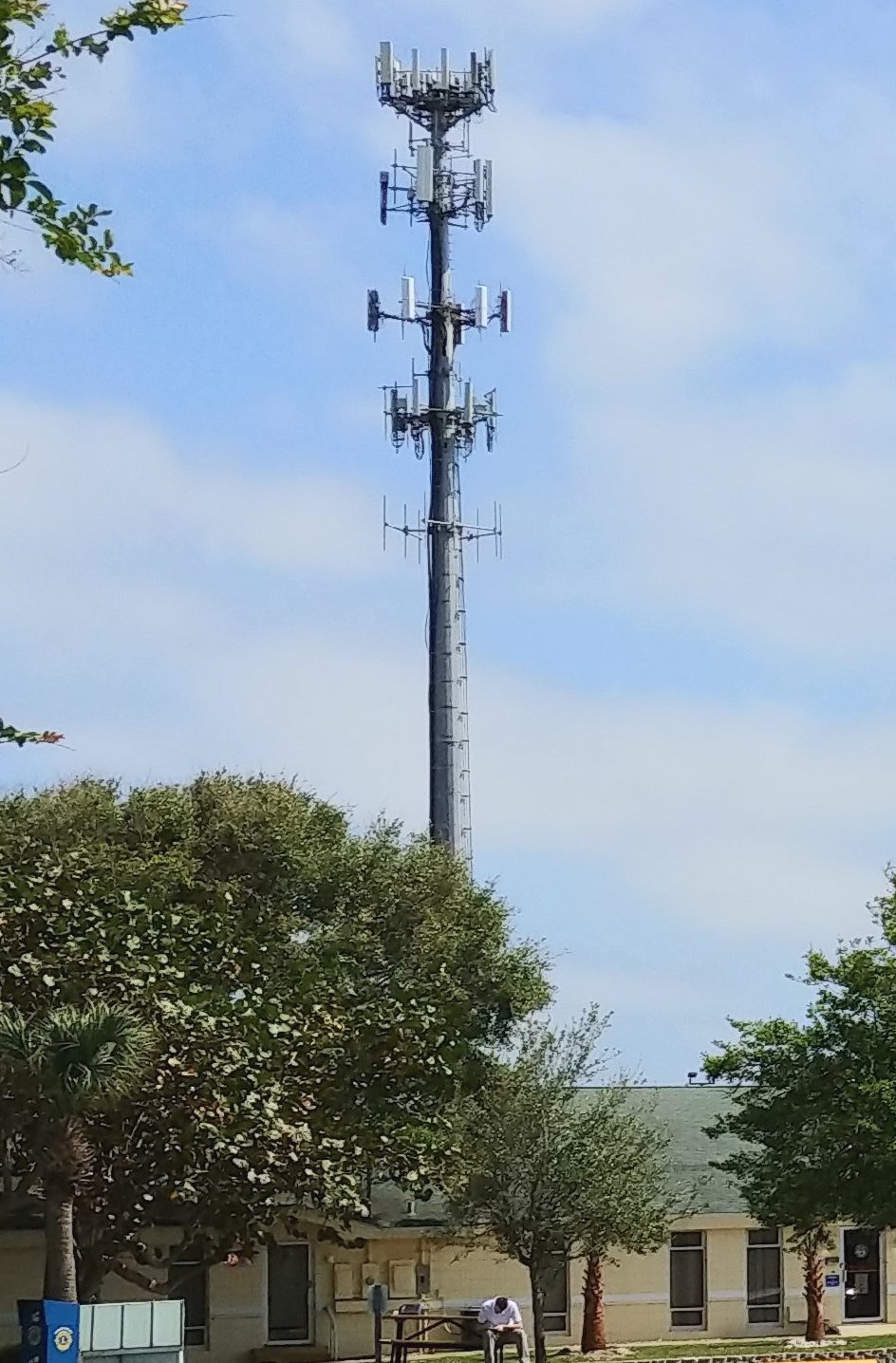
Conventional Macro Cell Tower
|
Some International Precautionary Exposure Guidelines
RF Units Conversion Table
EMF Services no longer performs standard RF compliance surveys. We provide only enhanced testing services that involve more detailed
data collection, and a more extensive and broader coverage report, than a conventional compliance survey. Our surveys
incorporate procedures and equipment to separately measure cellular power density, in addition to the composite power density
(the combination of all RF signals present). We use top quality professional equipment, and extensive procedural safeguards, to
ensure the highest degree of RF measurement accuracy.
The purpose of our testing services is not to provide a basis for contesting the siting of cell
phone towers or to seek their removal once sited. This position is not the result of an alliance between
EMF Services and the cellular service providers. They are not our clients. Rather, it represents
an effort to avoid leading you down the path toward a disappointing result. The RF levels near a cell
tower will not approach Maximum Permissible Exposures at ground level where people are present. Therefore,
from a legal perspective, grounds for such an action do not exist. Further, a court of law is not the best
venue for a challenge to the science on which existing standards are based. The likely result is disappointment
and a wasted financial expenditure. The best reason for testing and measurement services is to understand the field
levels that exist, and what can be done to reduce them.
|

Stealth Cell Tower
|
Standards vs. Guidelines - The Rationale for Exposure Testing
Regulations adopted by the Federal Communications Commission (FCC) in 1996, and fully
implemented in 2000, limit human exposure to electromagnetic radiation from cell phone,
broadcast, and other radio communication systems. Both U.S. and international standards
governing exposure to radio frequency (RF) fields have long existed, and the FCC regulations
were adapted from a pre-existing standard. They establish Maximum Permissible Exposures,
or MPEs, for the full range of frequencies encountered near transmitting equipment,
towers, and antennas. These are the formal exposure standards in the U.S., and have full regulatory force.
For cellular antennas on towers, the level of RF energy that one would realistically be exposed to is
usually less than 1% of the MPE. For broadcast towers and building mounted cellular antennas, much higher
exposures are possible, although the MPEs are still unlikely to be exceeded in areas accessible to
the public. So why are people concerned about cell towers, or RF exposure in general? Is some
caution warranted? Three reasons for this concern are recognized:
Some people don't trust the cell phone companies or the government to act with the public's
best interest in mind. Many people equate the potential adverse health effects of cell phone use, which has received
a lot of media coverage, with the presence of cell towers. (In reality, the energy that one is
exposed to while holding a cell phone to the head is far greater than one is exposed to in the vicinity
of a cell tower.) The existing exposure limitations are based primarily on the avoidance of energy deposition in
the body sufficient to cause heating of tissue. More recent research data indicates that
some types of radio frequency fields influence cellular function through mechanisms that do not
involve heating. Therefore, the existing limitations may be based upon incomplete and outdated
science, and thus not fully protective.
To address the issues raised by recent health effects research (#3 above), it is necessary to look beyond the current
exposure limits. Through a review of research on exposure to radio frequency radiation, it
is possible to identify a range of numbers below which no adverse effects have been noted (or which have been
reported only in limited or questionable studies), and above which potentially adverse effects have
been seen. This range of numbers can form the basis for a "precautionary guideline." The science from
which it is derived is not, at this time, sufficient in strength or consistency to permit the revision of
existing standards. However, reference to such a precautionary guideline will permit those individuals
who seek a level of protection beyond that conferred by existing standards to do so in a rational manner
while research proceeds on this important public health issue.
|

Cell Antenna on Roof Parapet

Back Radiation into Office Space
|

Rooftop Cell Site
Technical Challenges for RF Site Surveys
Measurement of the emissions from cell towers presents particular technical challenges
beyond those encountered for broadcast antenna sites. To understand these challenges,
a few comments about radio frequency measurement are required.
Protocols for the measurement of
RF energy for the purpose of human exposure assessment often recommend the use of an "isotropic
broadband probe" because this type of sensor responds equally to energy arriving from any direction,
and over a broad frequency range, as does the human body. These instruments are commonly used because
they permit a quick and simple measurement. Unfortunately, some of the meters used for typical RF
compliance surveys are unable to accurately measure the low power densities present at some cell sites.
An alternate approach is required.
A related problem involves the concurrent presence of other signals besides those from the cell
phone system. The "broadband" characteristic of the isotropic broadband probe means that it will measure
any signals across a wide range of frequencies. The reading produced by the
instrument will be the combination of all signals present. In a large number of cases, the other signals
present near a cell tower will be as strong as the cellular signals that one is trying to measure.
Realistically, this composite measurement of all signals may be the most relevant exposure
metric, but an interpretation of the significance of a reading sometimes requires that one know the frequency
of the signal that produced it. For instance, is it FM, TV, cellular, or something else?
One of the most significant RF measurement problems, and one responsible for some of the greatest inaccuracy,
involves an instrument erroneous response that can occur when there are two or more strong signals present at
the same time. A very large proportion of antenna sites (cell and broadcast) now have multiple strong signals.
Instrument design can minimize this problem, but many of the commonly used isotropic broadband meters
perform very poorly in this multi-signal environment. The result is a reading that is much higher
than actual, sometimes double (100% error).
An additional challenge results from the fact that power density levels at a cell tower site are not
always constant, as they usually are at a broadcast antenna site. People use their cell phones more at
some times of the day, and on some days of the week, than at others. The cellular service
providers maintain additional capacity in the form of multiple channels which will become active as
needed to meet demand. Each active channel adds to the measured power density at the cell site. The
variable nature of power density levels at some sites must be taken into account. When necessary, we employ
timed signal averaging or data logging to produce an accurate assessment.
|

Isotropic Antenna for Spectrum Analyzer
|

Keysight Spectrum Analyzer for RF Measurements
How We Handle the Measurement Challenges
RF measurement surveys conducted by EMF Services employ procedures and equipment to address
each of the challenges noted above. A spectrum analyzer is used for identification of RF sources, and for
assessment of the relative magnitude of signals in different frequency ranges. The use of this instrument
with a calibrated antenna will allow a sensitive and precise "channel power measurement" across selected
frequency ranges, or measurement of the strength of an individual broadband signal. This completely
eliminates the problem of inaccuracy in the presence of multiple strong signals. It also permits a
determination of the amount of power that is present in different parts of the RF spectrum, such as
FM radio, TV, cellular, etc. Another benefit of spectrum analysis is the ability to identify the
cellular carriers that are present at a site. Our comprehensive analytical report summarizes all this
data in a concise and understandable format, but includes an Appendix with detailed site data, such as
the spectrum analyzer plots shown below.

RF Spectrum at Cell Site
|

700 MHz Cellular Band
|
Unrealistic Exposure Guidelines
Most people recognize that the most extreme position on any issue is seldom the best. Likewise,
the lowest exposure guideline number is not necessarily the best number. At the far extreme, we could all be advised
to live in a welded steel box with no windows and a leakproof RF door. How practical is that, and how good would
that quality of life be? It is time we allowed reason to prevail over fear.
We are sometimes presented with questions about the guidelines referenced by other organizations. The
frequency at which this occurs has prompted the following comments about the guidelines being used by some groups:
There is no stated scientific basis for the recommended levels. They seem to be derived from what a
small group of people (possibly one person) felt were best, based on personal experience. In at least one case,
they were based upon the lowest displayable level on the instrument that their practitioners are advised to use.
Such recommendations are neither objective nor scientifically verifiable, and should not be generalized to whole
populations. This is an example of how science should not be done. The range of levels in different categories, ranging from lowest to highest exposure, appear to be
completely arbitrary as there is no supportable explanation for this stratification, such as a rising risk curve or
dose-response ratio in any type of study. The lowest recommended exposure level is often unachievable in a typical suburban or urban environment without shielding
the building, or at least shielding specific rooms of the building. Any recommendation which implies that most people in
the world today are living in a hazardous environment should be considered suspect. At the best, it is fear-mongering that
fosters the development of phantom illness. Most practitioners in this field are fundamentally responsible and highly ethical
people who are committed to making a positive difference in their clients' lives, but reliance on a standard with no discernible
scientific basis threatens their legitimacy.
|
EMF SERVICES LLC
845-276-9500

Providing Services Worldwide
Site contents Copyright © 2024.
| | 


