|

Plumbing Current Magnetic Fields
EMF from Water Pipes
|
The Water Pipe EMF Problem
The most common source of elevated magnetic
field readings (high EMF) in homes is electrical current on a water pipe. This is more
accurately described as neutral current diversion into a metallic
plumbing and grounding system, also referred to as plumbing current,
or ground current. Small commercial buildings can also exhibit this
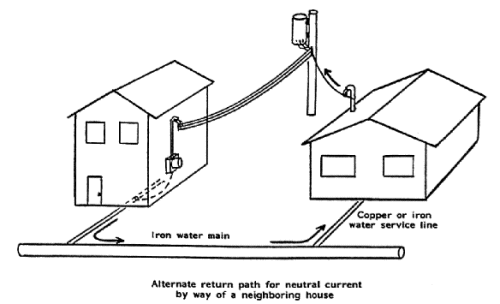
condition. The situation exists when some of the current that would
normally return through the electrical service line feeding the building
is instead channeled into the grounding system, where it
returns to the transformer by way of alternate paths, including water pipes, the public
water main, and neighboring residences. This unbalanced current creates
a strong magnetic field with a wide spatial extent. The type of power distribution
system used in the U.S., in combination with important National Electrical
Code grounding requirements, establish the underlying conditions for this
problem to occur. It is more common in communities with moderate to high
housing density, especially those served by overhead power distribution
lines, but it can occur anywhere.
Drawing by Ed Leeper from Silencing the Fields
Plumbing Current Remediation
This undesired current flow can be
blocked very effectively, and in a manner that is code compliant, by the
installation of a dielectric coupler, or insulating coupling, in the water supply line to the building. Several
strong cautions are necessary before this work is planned. In some extreme cases, the problem
results from a partial failure of the power feed to the building (open neutral), and can
represent a potentially serious electrical shock and fire hazard. If intervention
is undertaken without an analysis of the nature of the problem, and if
the integrity of existing electrical facilities is not verified, extremely
hazardous conditions can be created. In addition, a large sum of money
will have been spent on an ineffective solution.
We routinely resolve plumbing current problems, and can
coordinate the activities of local service providers at any location through telephone
consultation. There is a flat-rate fee of $200 for this service. A brief conversation is
provided at no cost to determine the nature of your problem, and to advise on the next steps.
If you are ready to proceed, make an online payment at the link below, and contact us to coordinate
the electrician's schedule with our availability. You should then download the
Electrical Testing Outline, which will help the electrician understand how the testing will be performed.
We will guide the electrician through the procedure over the phone,
evaluate the readings, and advise on how to proceed. This usually includes sending information to help a plumbing
contractor understand the work that is required. The stated price applies only to single family residences or duplexes.
Commercial or multi-occupancy buildings will incur higher costs.
Electrical Testing Outline (PDF)
Selection of an Electrician
Our advice for finding an electrician to work with us over the phone
is to start by asking friends if they have used one with good results.
Also, check referral and review sites and avoid anyone who has demonstrated questionable business ethics.
From there, narrow your search to the small companies, like a one to three person shop. The personal attention
to your problem and the level of craftsmanship are usually much higher. Avoid the large companies with the
largest ads, who are likely to just send out the next truck in rotation, and you never know what you will get.
Perhaps most important is to select a person who is open to working with you on something a little outside the
typical electrical job. They don't need to know anything about EMF problems or electrical current on water pipes. In fact,
it is usually best if they don't claim to know these things because they are easier to work with. A good attitude,
an open mind, and the ability to work cooperatively with another person is priceless. Prioritize those qualities
in your selection process.
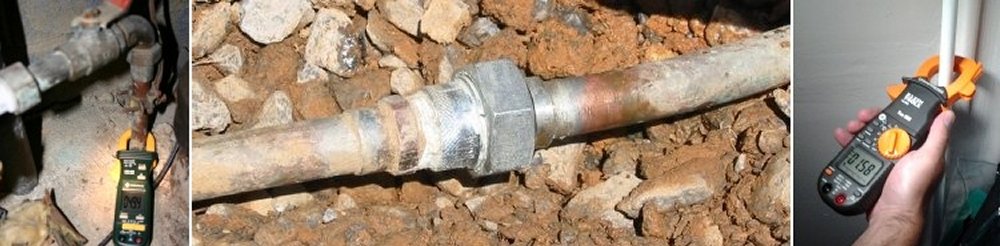
The one thing they must have is a good clamp-on ammeter, or amp clamp. Any
qualified electrician should have one, and it should have a digital readout with at least 1 decimal place. (We recommend
the Klein CL220 because it is widely available at reasonable cost.)
Here is what to tell the electrician that you need to have done:
Measure current on the incoming service conductors in the panel. Measure current on the incoming water line. Measure current on grounding conductors inside the house.
Additional Technical Explanation
Misinformation abounds on the causes and correction of plumbing current problems.
Some sources advise driving additional ground rods (does nothing). Others even
tell you to disconnect required grounds from the water pipe in the building (dangerous!). Still
others say it cannot be fixed, and suggest that you give up on the problem.
This is not a mysterious issue. It is understandable, explainable, quantifiable,
and in almost all cases, fully correctable. For those who wish a further explanation,
the following should be helpful:
Type I plumbing current is described above.
It results from current utilization within the building where the analysis
takes place. The magnitude of the problem tracks the changing power load as electrical
devices switch on and off. When power to the building is turned off, it goes away.
Correctable as described above. Type II plumbing current is also described above. It
results from current utilization in another building besides the one under analysis.
Power to the building under analysis can be turned off, and the utility meter can even be removed, but
the current still flows and the magnetic field is still present. The current magnitude can be seen
to vary as electrical devices in another building switch on and off. This problem can occur because
of a defective neutral in the service drop to the other building, but this is not always the case.
Type I and Type II often exist together in the same building, and can add or subtract. Correctable
as described above. Type III plumbing current exists when primary neutral
return current flows over the
secondary portion of the neutral system into the building and crosses over into the plumbing
system, usually because of a deficiency in the utility distribution system. This is
less common and of lower magnitude than Types I and II. It is usually correctable as described above,
but if current is flowing into the earth rather than into the water main, a different approach may be
required. An open neutral in the electrical service line to the building will often
result in very high, and highly variable, current on the water service line. This is universally recognized as a serious safety
problem among electric utilities and electricians. It is very important to note that the absence of any current measured
on a water line does not confirm that an open neutral condition DOES NOT exist. There may simply be no loads operating in the
building. Also, a measurement of many amps of current on the water line does not indicate that an open neutral condition DOES exist.
Only structured testing under controlled load conditions will permit this determination. A major implication of this is
that a plumbing contractor cannot use a simple current measurement as a singular indication that it is safe to cut into a pipe. A
voltage of 120 Volts or more could appear across the two ends of a cut pipe without warning. With wet hands on a copper pipe, this
could be a fatal mistake. Beast of Burden Testing - When the local electric company is called out to investigate
a customer complaint of high magnetic fields from a water line, they will often bring a load testing device commonly called the
"Beast of Burden." This will load each side of the incoming electric service in turn, as the tech measures voltages (called a
neutral voltage shift). The fallacy of this test is that as long as the house has an intact metallic water line, they will
conclude that everything is OK even if there is a completely open neutral connection in the service to the house! Unless
they use an amp clamp on the neutral conductor and on the water pipe, this test is meaningless. It is shocking how poorly
this simple problem is understood by the people who are responsible for delivering electric power to our homes and businesses.
Related Ground Current Issue
Earth Current refers to the flow of primary
return current through the earth back to the serving substation. It is not the type of
current discussed on this page, but it is accurately referred to as ground current.
Primary neutral return current enters the earth at
any point where the electrical system neutral is connected to a grounding electrode. This
condition is a consequence of the multi-grounded-neutral (MGN) system that is
universally used for power distribution in the US. This system evolved
early in the history of electrical power use because it offered a number of
safety advantages. A fundamental precept of the system is that the earth (which is conductive)
functions as a current return pathway to supplement the neutral system, and to handle
transitory overvoltages due to lightning or high voltage faults. This is a major route by which primary
current returns to the substation. The utility goes to great length to build
and maintain a low resistance ground grid at the substation to handle the current.
There may be adverse consequences from earth current flow,
such as the establishment of earth surface voltage gradients. This is especially true
for the dairy farming industry, where it is one component of the stray voltage issue.
It also becomes significant in the design of residential environments for electrically
sensitive individuals.
|
EMF SERVICES LLC
845-276-9500

Providing Services Worldwide
Site contents Copyright © 2024.
| | 


